Email IP Warm-Up: A Practical, Evidence-Based Approach for New Sending IPs
A practical guide to warming a new sending IP without relying on arbitrary volume charts, with emphasis on authentication, engagement and controlled scaling.
Why warm-up exists
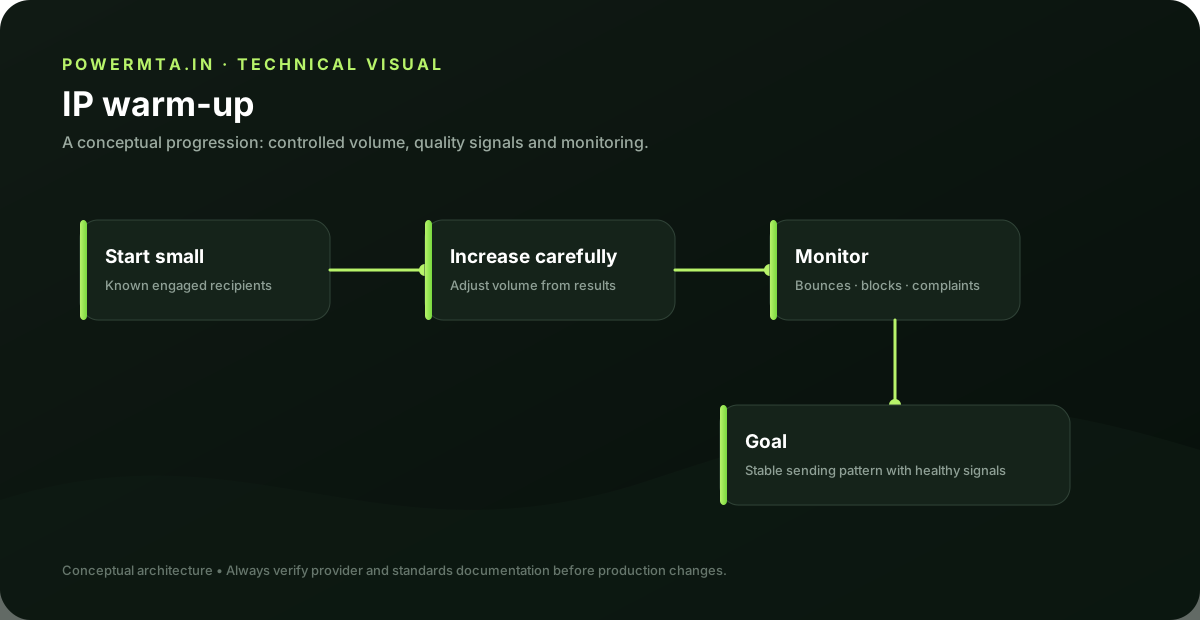
A new sending IP has little or no sending history with recipient networks. The purpose of a warm-up is to establish a predictable pattern of legitimate traffic while monitoring recipient responses. There is no universal schedule that guarantees inbox placement for every sender.
Prepare before the first campaign
- Configure forward and reverse DNS.
- Set up SPF and DKIM.
- Publish DMARC appropriate to your rollout stage.
- Enable TLS.
- Configure bounce and complaint handling.
- Verify unsubscribe behavior for promotional mail.
- Make sure the list contains recipients who actually expect the mail.
Start with your most engaged audience
Early traffic should provide clean feedback. Prioritize recipients who have a recent, legitimate relationship with your brand rather than starting with the oldest or least engaged segment. This gives receiving systems a clearer signal about the quality of your traffic.
Increase volume based on response
Instead of following a rigid “day 1 = X, day 2 = Y” table, use operational signals. If bounce and complaint rates remain controlled and delivery behavior is stable, increase gradually. If you see unusual deferrals, complaints or authentication failures, hold or reduce volume and investigate.
Keep message streams predictable
Avoid changing domains, IPs, From identities and message categories at the same time. A clean warm-up is easier to diagnose when the variables are controlled. If you have separate transactional and marketing streams, document how each is routed.
What warm-up cannot fix
Warm-up does not repair poor lists, unwanted mail, authentication failures or a history of complaints. Sending more slowly can reduce pressure, but it cannot make an unwanted message wanted.
Monitoring dashboard
- Delivery and SMTP response trends.
- Hard and soft bounce rates.
- Spam complaints.
- Authentication results.
- Deferrals by recipient domain.
- Engagement trends where measurement is reliable.
- Changes in sending volume and message type.
A professional rule of thumb
Think of warm-up as a feedback-controlled operational process, not a magic calendar. The safest schedule is the one your data supports. Document each volume change, watch the response, and be prepared to pause when the signals deteriorate.
A practical staged approach
There is no single volume schedule that fits every sender. A sensible process is to begin with a small, highly engaged audience, observe delivery signals, and then increase volume in controlled steps. The size of each step should reflect your normal campaign pattern, recipient mix and receiver responses.
What to do if deferrals increase
Hold the next volume increase. Inspect the SMTP responses and group them by recipient domain. If one receiver is deferring while others are normal, the issue may be receiver-specific. If many receivers are deferring, inspect authentication, reputation, infrastructure and list quality before continuing.
When to pause
Pause or reduce sending when you see a meaningful rise in complaints, hard bounces, authentication failures or unusual policy responses. Continuing to increase volume while the signals are deteriorating makes the cause harder to isolate and can increase the operational impact.
After warm-up
Warm-up is not a one-time ceremony. Maintain stable sending practices after the initial period. Large changes in volume, IP, domain, content or recipient mix can still change delivery behavior. Continue monitoring the same signals you used during the ramp.
Example of a controlled ramp
A sender could begin with a small segment of recent, opted-in recipients, observe the results, then expand to a larger engaged segment. The exact numbers should come from the sender's normal volume and recipient mix rather than a universal chart. The important control is that each increase is followed by observation.
Separate operational signals
Do not combine every negative signal into one “deliverability score.” A complaint spike, a hard-bounce spike and a receiver-specific 4xx response have different meanings. Track them separately so the next operational decision is based on the actual failure mode.
Document every change
Keep a short warm-up log containing date, volume, recipient segment, IP, domain, major message type and observed delivery signals. If performance changes, the log gives you a timeline to compare with DNS, content, provider or infrastructure changes.
Troubleshooting worksheet
When warm-up performance changes, compare volume, recipient segment, IP, domain, message type, authentication results and receiver responses. If only one recipient network changes, investigate that network separately. If several networks change together, inspect your own infrastructure and list quality. Do not increase volume to “push through” a deterioration in the signals.
Implementation checklist
- Authenticate the domain before increasing volume.
- Start with recipients who have a legitimate recent relationship.
- Increase volume in controlled steps.
- Track complaints, bounces, deferrals and authentication separately.
- Pause or reduce volume when signals deteriorate.
- Keep a written record of each warm-up decision.
A good warm-up is deliberately boring. Stable infrastructure, expected traffic, clean recipient lists and measured increases create a better operational signal than a rigid calendar that ignores what receiving networks are telling you.
Keep warm-up connected to list quality
A new IP cannot compensate for recipients who did not expect the message. Before increasing volume, confirm that the audience is legitimately subscribed and that old or inactive addresses are handled appropriately. The cleaner the audience, the easier it is to interpret the signals coming from receiving networks.
Operational note
A written warm-up record also helps future operators understand why volume was increased or reduced. That history is useful during migrations, provider changes and reputation investigations, especially when more than one person manages the sending infrastructure.
Sources & further reading
This guide is independently written. The references below are used to verify standards, platform requirements, or product-specific behavior where applicable.